
Share this
by Florian Lapierre, PhD, Microsampling Product Director on April 21,2026
How minimally invasive skin sampling is addressing a critical unmet need in dermatology research
Why Skin Sampling Needed a Rethink
Skin is one of the most accessible organs in the body, yet sampling has remained surprisingly invasive.
Traditional biopsy methods require local anesthesia, can cause scarring, and limit how often and where samples can be collected. For researchers, that is not just inconvenient. It limits what studies are possible.
As Professor Tarl Prow explains in the Harpera webinar: The Unmet Need, one of the biggest challenges in skin research has always been simple:
How do you collect enough meaningful samples without overburdening the patient?
In a field increasingly driven by molecular data, that limitation matters.
The Harpera™ microbiopsy punch was developed to change that.
What Makes Harpera Different
So what makes Harpera different in practice?
The Harpera microbiopsy punch is a minimally invasive skin microbiopsy device designed to collect sub-millimeter tissue samples quickly and with minimal discomfort. It enables:
-
Suture-free sampling with little to no pain
-
Repeatable collection across multiple sites
-
Access to viable tissue for molecular analysis
Unlike tape stripping, which captures only surface layers, Harpera collects living epidermal tissue, providing a real-time view of biological activity.
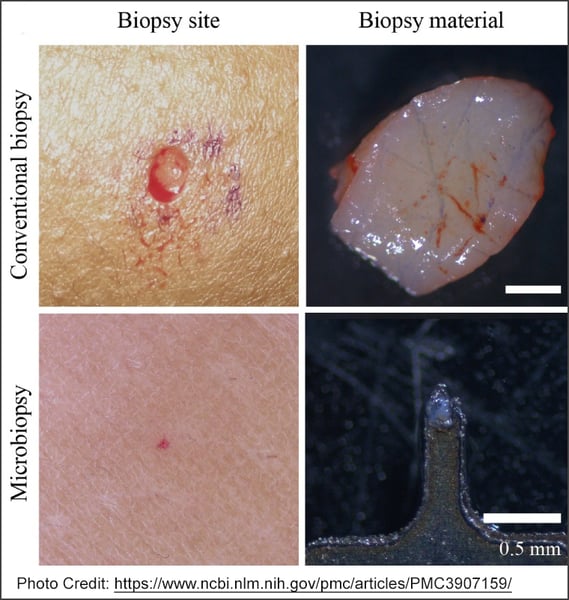
How Microbiopsy Compares to Traditional Biopsy
| Capability | Microbiopsy | Conventional Biopsy |
| Histopathological data | ||
| RNA analysis | ||
| DNA analysis | ||
| Live tissue analysis | ||
| No local anesthetic | ||
| No sutures | ||
| Minimal pain | ||
| No scarring |
Harpera is not designed to replace histology. It is designed to enable molecular insight at scale.
Watch the webinar to hear how this unmet need led to the development of Harpera.
Built for Molecular Analysis
Traditional biopsies focus on structure. Harpera focus on function. It supports:
-
RNA sequencing
-
qPCR and gene expression
-
Biomarker analysis
This allows researchers to study what is happening in the tissue in real time, not just how it looks.
What Harpera Captures:
Harpera consistently collects:
-
Full-thickness epidermis
-
A small portion of superficial dermis
Because key biological processes occur in the epidermis, this enables highly relevant molecular insight.
At the same time, dermal signals may be repressed, which is important when designing studies.
Harpera isolates signals rather than averaging them.
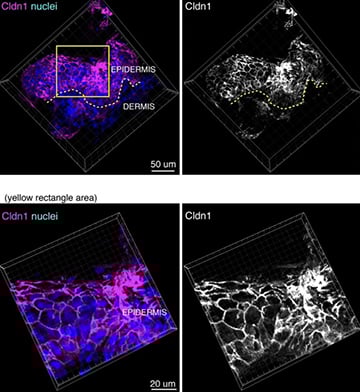
Precision That Enables Spatial Insight
Harpera's small sample size enables highly localized sampling. In studies comparing microbiopsy to swabbing:
-
Microbiopsy detected signal only with lesions
-
Swabs detected signal beyond lesion boundaries
This level of precision enables:
-
Mapping gene expression across lesions
-
Identifying disease margins
-
Studying localized responses
Sampling at Scale
Because its minimally invasive, Harpera enables multi-site sampling across the body. In one study:
-
Over 100 participants
-
More than 1,000 samples collected
-
Consistent molecular data across all body sites
This makes Harpera:
-
Scalable for large studies
-
Suitable for longitudinal sampling
-
Reproducible across anatomical regions


Comments (1)