
microsampling for infectious disease studies
A small volume of blood obtained from a finger-stick microsample enables researchers to analyze antigens, immune-response antibodies, cytokines, and mRNA vaccine efficacy across multiple infectious diseases. Effective prevention of future pandemics depends on a comprehensive understanding of disease pathogens and mechanisms.
Reliable data generation requires both access to remote populations and the collection of high-quality blood samples. Devices such as the VAMS®-based Mitra® device facilitate remote blood sample collection for research on SARS-CoV-2, influenza, RSV, and other infectious diseases.
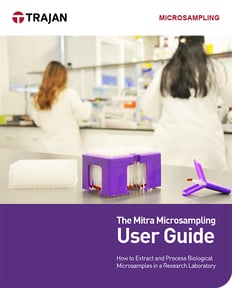 Microsampling User Guide
This technical user guide is designed to get you started with microsampling. The printed guidance from our technical director helps you make initial decisions on best practices for achieving solid analytical validations in your research projects. What microsample volume is needed for your assay? What analyte classes are compatible with microsampling? How do you process microsamples in the lab? Download the guide to find answers to these questions, and more!
Frequently Asked Questions (FAQs)
Mitra® devices have been used in serology studies of infectious diseases, including SARS-CoV-2 and Influenza, among others.
During the COVID-19 Pandemic, remote microsampling devices have been deployed to study populations across many geographical areas.
Thousands of people have used our devices to collect blood samples at home for bioanalysis in labs at the National Institutes of Health (NIH), LGC Group, Stanford University, Harvard, University of Rochester, and other organizations globally to help increase the science community's understanding of antibodies and immunity against viral pathogens.
Since the beginning of the COVID-19 Pandemic, researchers from many organizations have published articles on successful serology studies of SARS-CoV-2 using microsampling devices.
Research provided in our Technical Resource Library illustrates:
- > 99% Mitra sampling success rate in studies with thousands of remote participants
- Assays compatible with Mitra samples with 100% sensitivity and 100% specificity with high confidence intervals
- Ability to detect IgG, IgM, IgA and neutralizing antibodies from dried blood microsamples
- Immunoassay methodology for Roche Elecsys®, Luminex, Quanterix Simoa®, and more
Access our Resource Library for these details plus insight into cytokines and a multiplex assay that uses microsampling to simultaneously measure >30 strains of influenza.
Volumetric microsampling is compatible with many analytes. Our Technical Resource Library offers literature and resources detailing analytes extracted with Mitra. To find specific information, enter your analyte of interest in the Search field.
Mitra® devices, with absorptive VAMS® tips consistently collect homogeneous samples with a 99% acceptance rate. With the support of illustrated instructions and demo videos, study participant's can reliably collect precise, fixed-volume samples suitable for laboratory analysis.
Mitra® devices also overcome hematocrit (HCT) bias found in DBS cards, where non-homogeneous blood spots on filter paper lead to greater variability and higher failure rates.
Published studies demonstrate that dried capillary whole blood microsamples of 10, 20, or 30 µL provide sufficient material for effective extraction and analysis.
These samples produce high-quality data comparable to venous blood. Mitra samples show strong correlations with plasma or serum samples for nucleocapsid (R2 = 0.9957), RBD (R2 = 0.9929), and spike (R2 = 0.9918) proteins. The literature includes case studies demonstrating microsampling in research.
For more comparative studies and examples, please visit the Technical Resource Library.
The process of transitioning to microsampling takes about 6-8 months and is divided into three phases, with ongoing technical support from the Neoteryx Microsampling Team:
- Education: [1 - 2 weeks] The introductory phase
- Evaluation: [4 - 6 weeks] Extraction, linearity & signal-to-noise studies
- Validation: [6 - 8 months] Validating your method
See our Microsampling User Guide for details.
Infectious Disease Blogs
Our website features many blogs about infectious disease studies that leverage remote microsampling to enable people to participate in science while staying safe at home. Click the button below to explore all of our infectious disease blogs, gathered together in a single, curated list.
Interview on an NIH Study
In this interview, research scientist Kaitlyn Sadtler, PhD, at the National Institute of Biomedical Imaging and Bioengineering (NIBIB), part of the National Institutes of Health (NIH) discusses the first serology study of the novel coronavirus known as SARS-CoV-2. NIH researchers used remotely collected blood microsamples to help identify undetected cases of COVID-19 illness.
request pricing information
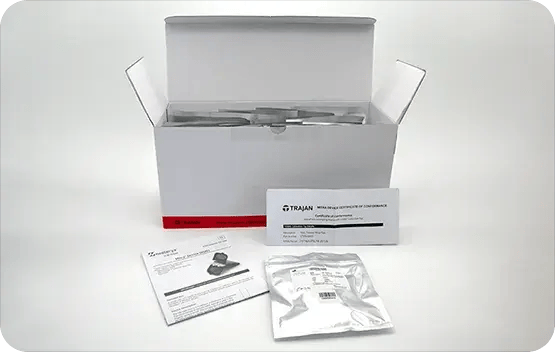
innovate your approach to science and research
Advancing to Microsampling Begins With a Conversation.
