
microsampling in clinical trials
Microsampling devices for remote specimen collection have the potential to transform clinical trials. This approach can expand participant enrollment, increase diversity, and reduce costs, thereby accelerating drug development. For pediatric or adult trials requiring frequent blood collection, Mitra® microsampling devices offer both convenience and volumetric accuracy.
Dried blood microsampling reduces costs by eliminating the need for cold storage and specialized shipping. Using volumetric devices, staff or participants can collect samples either at the trial site or at home and send them to the laboratory using standard mail services. Precision sampling is accessible to all participants, regardless of location or time.
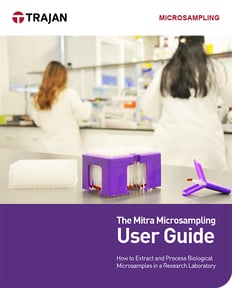 Microsampling User Guide
This technical user guide is designed to get you started with microsampling. The printed guidance from our technical director helps you make initial decisions on best practices for achieving solid analytical validations in your research projects. What microsample volume is needed for your assay? What analyte classes are compatible with microsampling? How do you process microsamples in the lab? Download the guide to find answers to these questions, and more!
Frequently Asked Questions (FAQs)
Yes, volumetric microsampling devices have been used in many clinical trials around the world. Our Technical Resource Library includes a searchable selection of published literature discussing studies and trials that applied remote specimen collection and volumetric microsampling. Type "trial" or your analyte of interest in the library's search field to find journal articles, presentations and application notes.
Many analytes can be extracted using volumetric microsampling and are compatible with Mitra® devices with VAMS® technology. Our Technical Resource Library provides information on the types of analytes that have been evaluated by researchers using volumetric microsampling. Type your analyte of interest in our Technical Resource Library search field to find the information you seek.
Mitra® devices, which use volumetric microsampling, demonstrate high sample success rates. Mitra’s absorptive VAMS® tips achieve 99% acceptance rates for homogenous samples.* When users follow the provided instructions and demo videos, they can reliably collect fixed-volume samples suitable for laboratory analysis.
These devices address hematocrit (HCT) bias often seen with DBS cards, where non-homogeneous blood spots on filter paper result in greater variability and higher failure rates.**Data on sample success rates are discussed in published research articles in our online Microsampling Resource Library.
Published research demonstrates that dried capillary whole blood microsamples of 10, 20, or 30 µL are sufficient for effective extraction and analysis. These samples produce high-quality data comparable to venous blood. The literature includes case studies highlighting microsampling in research. Visit the Technical Resource Library to review comparative studies detailing others' achievements with microsampling.
The first step in transitioning from other sampling methods to microsampling is an introductory, initial education phase, which may take about 4 weeks. The next steps involve evaluation and validation. The Neoteryx Microsampling Team and Technical Director can provide support through all the steps:
Education: The introductory phase
Evaluation: Extraction, linearity & signal-to-noise studies
Validation: Validating your method
See our Microsampling User Guide for details.
While we are exploring this capability as a future advance in the microsampling industry, traditional wet blood samples and conventional phlebotomy are still used for most standard health panels and the complete blood count (CBC).
Dried blood sampling eliminates the requirement & expense of a certified phlebotomist to perform the blood sample collection. In addition, the shipping of dried blood samples to a central laboratory doesn’t require costly cold-chain shipping supplies/methods, but instead can be shipped via standard post.
Clinical Trials Blog List
We work with many organizations that conduct clinical trials, so we cover this topic a lot in our content. Click the button below to explore our blogs on how to improve clinical trials with remote microsampling – all gathered together in a single, curated list.
Microsampling for Virtual Clinical Trials: Interview
In this episode of the Microsamplify Podcast, Anders Millerhovf, co-founder and CEO of Clinical Trial Consultants (CTC) in Sweden, explains how remote microsampling devices and digital communications enable large, decentralized trials with great success.
Lower Clinical Trial Costs with Microsampling
Design a hybrid or decentralized clinical trial (DCT) with remote microsampling and telehealth communications so your study volunteers can participate from home…or anywhere. Remote sampling decreases site & staffing costs while increasing the size & diversity of your study population across wider areas.
request pricing information
innovate your approach to science and research
Advancing to Microsampling Begins With a Conversation.
