
Revolutionize Research with Remote Microsampling
VAMS® technology is an advanced microsampling solution that enables precise, remote blood collection for applications in clinical research, public health, and epidemiology. Mitra® devices offer volumetric precision and facilitate remote specimen collection, supporting the acquisition of high-quality samples and reliable data.These tools enable a true volumetric sampling approach, addressing many limitations associated with traditional dried blood spot (DBS) methods.
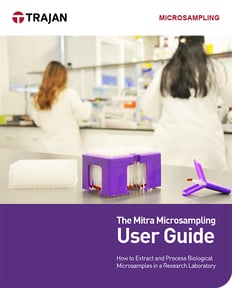 Microsampling User Guide
This technical user guide is designed to get you started with microsampling. The printed guidance from our technical director helps you make initial decisions on best practices for achieving solid analytical validations in your research projects. What microsample volume is needed for your assay? What analyte classes are compatible with microsampling? How do you process microsamples in the lab? Download the guide to find answers to these questions, and more!
Frequently Asked Questions (FAQs)
Yes, our microsampling devices with volumetric technology have been used in research studies worldwide. Our Technical Resource Library includes a searchable collection of published literature on research studies and trials involving both adult and pediatric study participants.
Type your analyte of interest in the library's search field to find journal articles, presentations, and application notes from third-party research groups.
Our Technical Resource Library provides information on the types of analytes that have been evaluated by researchers using the Mitra® device with VAMS® technology.
Type your analyte of interest in our Technical Resource Library Search field to find the information you seek.
The absorptive VAMS® tips on Mitra achieve 99% acceptance rates for homogenous samples.* By following the illustrated instructions and demo videos provided study participant's can reliably collect fixed-volume samples suitable for laboratory analysis.
Trajan microsampling devices address hematocrit (HCT) bias found in DBS cards, where non-homogeneous blood spots on filter paper result in greater variability and higher failure rates.*
Data on sample success rates are discussed in published research articles in our online Microsampling Resource Library.Example: https://www.medrxiv.org/content/10.1101/2021.01.27.21250570v1.full
Published research demonstrates that dried capillary whole-blood microsamples of 10, 20, or 30 µL provide reliable extraction and analysis. These samples produce high-quality data comparable to venous blood.
Visit the Technical Resource Library. for case studies highlighting microsampling in research.
Trajan Microsampling devices remove the need for a certified professional to collect samples, reducing associated costs. Additionally, transporting dried blood samples to a central laboratory does not require expensive cold-chain shipping and can be done via standard post.
Research Blog Listing
Read from a selection of blogs to learn about all the different ways that remote microsampling is being applied in public health studies, epidemiology research, and related programs. Click the button below to explore our blogs on microsampling research, gathered together in a single listing.
Microsampling in Research: Interview
We spoke with Jennifer Van Eyk, PhD, a Professor of Medicine at Cedars-Sinai Medical Center. She also co-directs Cedars-Sinai Precision Health. Dr. Van Eyk discusses her research on high throughput quantitative proteomics and disease-induced biomarker studies. The Van Eyk Laboratory at Cedars-Sinai is interested in the molecular basis behind a range of cardiovascular disorders.
request pricing information
innovate your approach to science and research
Advancing to Microsampling Begins With a Conversation.
